
At a Glance
Nepal contributes less than 0.1% of global greenhouse gas emissions, yet it stands on the frontlines of the climate crisis—facing melting glaciers, landslides, and unpredictable monsoons. But now, Nepal is turning its vulnerability into opportunity. With some of South Asia’s most ambitious carbon trading regulations and enormous untapped hydropower potential, Nepal is positioning itself as an important player in the global effort to decarbonize—and earn revenue while doing so. This article explores how Nepal’s new carbon market strategy could work, what it will take to succeed, and what it means for the region.
Introduction
Nestled in the Himalayas, Nepal faces a stark climate paradox: it is among the world’s most vulnerable countries to climate impacts—glacial melt, landslides, erratic monsoons—while contributing a negligible fraction of global emissions. Yet, in a bold strategic pivot, Nepal is transforming this vulnerability into value. With over 45,000 MW of untapped hydropower potential and a commitment to achieve net-zero emissions by 2045, the country is now operationalizing a market-based climate strategy through the Carbon Trade Regulations, 2082.
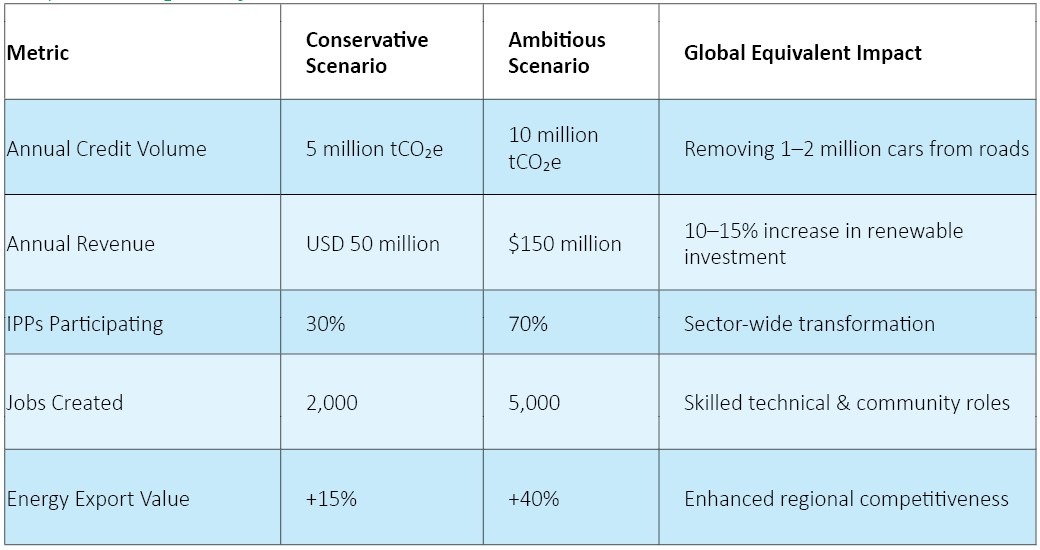
For Nepal’s 70-plus Independent Power Producers (IPPs), which account for more than 60% of the nation’s 2,200 MW installed capacity (estimated), this framework is not merely regulatory compliance—it is a financial lifeline. By converting clean energy into tradable carbon credits, Nepal aims to unlock a new revenue stream that could reach USD 50–150 million annually by 2030, fundamentally altering the economics of renewable energy development in South Asia.
By effectively valorizing its “green gold,” Nepal has the opportunity to transcend its vulnerability to climate change and emerge as a climate-positive frontrunner—offering a replicable pathway for other developing nations and demonstrating that scale is no barrier to substantive climate leadership.
This article explores Nepal’s carbon market framework through an implementation-focused lens, assessing its global relevance, structural challenges, and strategic pathway to becoming a credible supplier of high-integrity carbon credits.
The Carbon Market Framework: Built for Integrity and Impact
Nepal’s carbon regulations arrived amid growing scrutiny of global carbon markets, where studies suggest only 20–30% of voluntary credits represent real emissions reductions. In response, Nepal’s framework incorporates several integrity safeguards:
- 5% automatic retirement of credits to Nepal’s Nationally Determined Contribution (NDC), preventing double counting and ensuring exported reductions do not undermine domestic targets.
- 10% revenue sharing with the government, ensuring public benefit and transparency.
- Local government endorsement required for all projects, fostering community ownership and alignment with local development plans.
- Designated National Authority (DNA) to oversee project validation, verification, and issuance, centralizing quality control.
These measures are designed to position “Nepal Hydropower Credits” as premium commodities in quality-conscious markets, particularly under Article 6 of the Paris Agreement.
The Financial Catalyst: Carbon Revenue as a Game-Changer for IPPs
Hydropower development in Nepal has long been challenged by high upfront costs and modest domestic tariffs, averaging $0.07/kWh. Carbon credits introduce a vital secondary income stream:
Table 1:
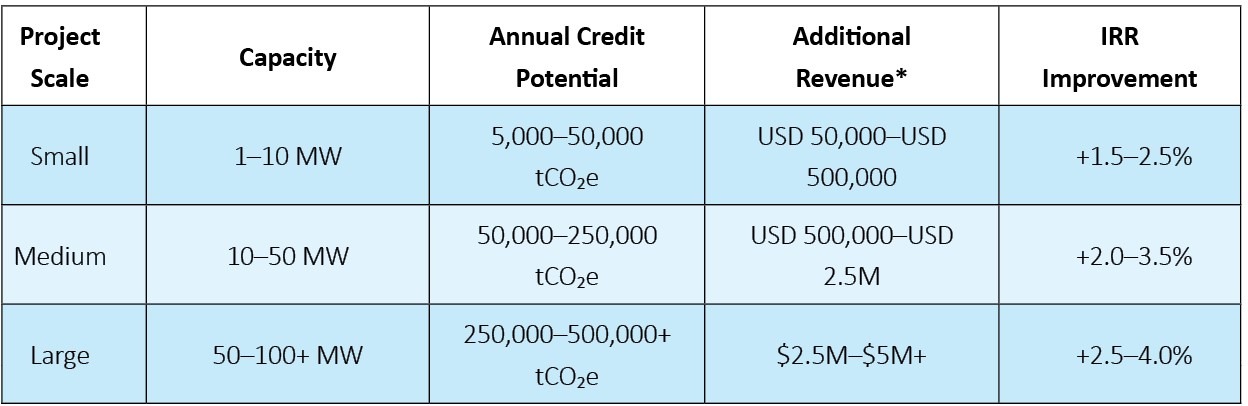
For a 10 MW run-of-river project, this translates to USD 320,000–USD 400,000 in annual carbon revenue—often the difference between marginal viability and bankability.
Learning from Global Pioneers: Chile and Costa Rica
Nepal’s framework draws intentional lessons from two successful models:
Chile’s Energy-Led Carbon Integration
Chile established a National Greenhouse Gas Inventory System early, developed 10+ sector-specific methodologies, and created the Chile Carbon Foundation to support private developers. Result: $120 million in carbon transactions since 2017, primarily from renewable energy.
Lesson: Parallel capacity building with the private sector accelerates market uptake.
Costa Rica’s Community-Focused Forestry Credits
Costa Rica’s Payment for Ecosystem Services (PES) program has distributed over $500 million directly to landowners since 1997, supported by satellite monitoring and transparent benefit sharing. Result: Forest cover increased from 21% to over 52%.
Lesson: Equitable benefit-sharing builds lasting social and political support—critical for Nepal, where 40% of the population lives near potential project sites.
The Implementation Gap: Four Critical Challenges
Capacity Bottleneck
The newly formed DNA has fewer than 10 full-time technical experts to evaluate projects across sectors. At this capacity, approval timelines could stretch to 12–18 months, risking early market frustration.
Front-End Financing Gap
Developing a bankable carbon project requires USD 50,000–USD 200,000 upfront for documentation, validation, and verification. Most of Nepal’s IPPs—especially smaller developers—lack this liquidity, creating a “catch-22” scenario.
Methodology Desert
While the regulations reference international standards, Nepal-specific methodologies for key project types—such as community micro-hydro or mountain forest conservation—are absent. Developing each can take 12–24 months, stalling the project pipeline.
Market Access and Price Volatility
Individual IPPs selling 20,000–50,000 credits annually have little bargaining power in global markets where prices fluctuate between USD 2–15/credit. Without aggregation, Nepali projects risk selling at the bottom of this range.
A 24-Month Implementation Roadmap
- Phase 1: Foundation Building (Months 1–12): Launch a Carbon Project Preparation Facility: A USD 10 million blended fund with GCF grant component to support 20 bankable projects within 12 months. Secure a Bilateral Anchor Agreement: Partner with Switzerland or Japan for a 500,000 tCO₂e purchase commitment over three years, establishing a price floor. Accelerate DNA Capacity: Deploy seconded international experts via UNDP/World Bank to train 50+ government staff on Article 6 procedures.
- Phase 2: Market Activation (Months 13–24): Create a Nepal Carbon Credit Pool: An SPV to aggregate credits from smaller IPPs, targeting 1 million+ tCO₂e annually by Year 2. Develop Critical Methodologies: Fast-track Nepal-specific hydropower and community forestry methodologies using CDM templates. Build Digital Infrastructure: A blockchain-based National Carbon Registry (USD 2–3 million investment) integrated with international systems.
The Carbon Trade Regulations, 2082, signify far more than a conventional climate policy instrument; they constitute a deliberate economic development strategy that synchronizes global climate finance with national priorities of energy security and sustainable growth.
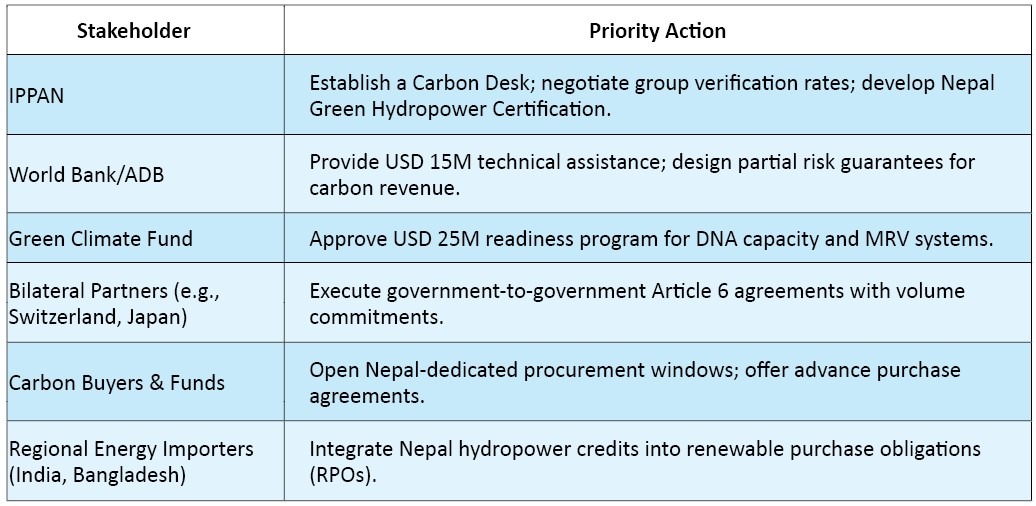
Strategic Roles for Stakeholders
Table 2:
Projected Impact by 2030
 Conclusion
Nepal stands at a rare and strategic confluence of advantages: vast endowments of clean energy resources, a rapidly maturing global carbon market, and an increasingly progressive regulatory architecture. By effectively valorizing its “green gold,” Nepal has the opportunity to transcend its vulnerability to climate change and emerge as a climate-positive frontrunner—offering a replicable pathway for other developing nations and demonstrating that scale is no barrier to substantive climate leadership. The Carbon Trade Regulations, 2082, signify far more than a conventional climate policy instrument; they constitute a deliberate economic development strategy that synchronizes global climate finance with national priorities of energy security and sustainable growth. While the regulatory framework is conceptually robust, its transformative potential will be realized only through decisive and timely operationalization.
The priorities ahead are unequivocal. The Government of Nepal must accelerate the conclusion of bilateral agreements and rapidly strengthen the operational capacity of the Designated National Authority. As umbrella organization of Nepal’s private developers, the Independent Power Producers Association of Nepal (IPPAN) should catalyze the market by advancing “first-mover” projects that signal readiness, credibility, and scale. International partners, in turn, must commit resources to the Carbon Project Preparation Facility and deliver targeted technical assistance to de-risk early implementation and crowd in private investment.
(Khatiwada is a Board Director of Sanima Mai Hydropower Limited )
References
- Government of Nepal, Ministry of Forests and Environment. (2025). Carbon Trade Regulations, 2082.
- Nepal Electricity Authority (NEA). (2024). Annual Hydropower Report.
- Independent Power Producers Association of Nepal (IPPAN). (2024). Market Analysis and Member Survey.
- World Bank. (2023). Nepal: Hydropower Development and Regional Integration.
- UNFCCC. (2023). Article 6 Implementation Partnership Case Studies: Chile and Costa Rica.
- UNDP Nepal. (2024). Climate Promise Programme Annual Report.