
Nepal’s energy journey over the past two decades has been nothing short of transformative. For a country once synonymous with chronic load-shedding and constrained supply, the current narrative of surplus generation, rising private investment, and regional power trade would have seemed ambitious not long ago. This progress is the result of sustained policy intent, institutional effort, and—critically—the confidence and commitment of the private sector. Yet, even as installed capacity grows and connectivity improves, recent climate-related events have served as a sobering reminder that progress cannot be measured by megawatts alone. Erratic monsoons, prolonged dry seasons, floods, landslides, and sediment-laden rivers have exposed underlying vulnerabilities in how the energy sector is planned, built, and governed. These disruptions are not isolated incidents; they are signals of a changing operating environment that demands a fundamental shift in thinking. The central question facing Nepal’s energy sector today is therefore not whether it can grow further, but whether it can grow stronger—more resilient, more adaptive, and more strategically aligned with the realities of climate uncertainty and market evolution.
An Institutional Structure Built for a Different Era
The current architecture of Nepal’s energy sector reflects its historical priorities. Policy formulation rests with the Ministry of Energy, Water Resources, and Irrigation. Regulation is entrusted to the Electricity Regulatory Commission. Nepal Electricity Authority occupies a dominant position across generation, transmission, distribution, and system operation. Alongside this, Independent Power Producers have emerged as the primary engine of capacity expansion, mobilizing private capital at scale. This structure has delivered results during a period when the overriding national objective was to end electricity shortages. Centralized decision-making, vertically integrated operations, and standardized power purchase arrangements were effective tools in a scarcity-driven environment. The success of this approach should not be understated.
However, the context has changed. Nepal’s power system is no longer defined by shortage alone. It is increasingly characterized by seasonal surplus, system complexity, and exposure to climate risk. The same institutional arrangements that once enabled rapid expansion now face new limitations. Overlapping mandates can slow decision-making. Transmission delays can undermine otherwise viable projects. Ambiguities in risk allocation can erode investor confidence, particularly when climate variability introduces additional uncertainty. A structure designed for linear growth is now being tested by non-linear risks.
Climate Change: From External Threat to Internal Constraint
Climate change has moved from being an abstract environmental concern to a concrete operational reality for Nepal’s energy sector. Hydropower, which anchors the country’s electricity mix, is inherently sensitive to hydrological patterns. Variations in river flow affect not only annual generation but also firm energy, seasonal reliability, and financial predictability.
In recent years, developers and operators have witnessed more frequent extreme events—sudden floods, increased sedimentation, slope failures, and prolonged low-flow periods. Landslides have disrupted transmission corridors. Access roads have been washed away. Construction schedules have been repeatedly interrupted. These impacts carry direct economic costs, but they also introduce systemic risk when multiple assets are affected simultaneously.
Despite this, climate resilience is still too often addressed at the project level, treated as a technical design challenge rather than a sector-wide governance issue. Individual developers are expected to internalize risks that are, by nature, systemic. This approach is neither fair nor efficient. True resilience cannot be built in isolation; it must be embedded across policy, regulation, planning, and market design.
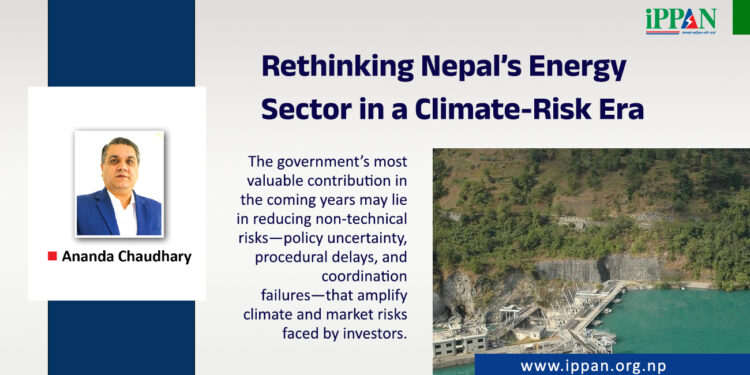
The government’s most valuable contribution in the coming years may lie in reducing non-technical risks—policy uncertainty, procedural delays, and coordination failures—that amplify climate and market risks faced by investors.
A climate-constrained future requires the energy sector to internalize uncertainty as a baseline condition. This means planning for variability rather than averages, designing for extremes rather than norms, and coordinating across institutions whose decisions collectively shape system performance.
Revisiting Roles in a More Complex System
As climate risk intensifies and the power system grows more interconnected, clarity of roles becomes increasingly important. For government institutions, the priority must shift toward strategic stewardship. Policy frameworks need to be forward-looking, grounded in realistic climate scenarios, and aligned with long-term development objectives. Transmission planning, in particular, must be elevated as a national strategic function rather than a reactive response to project-specific needs. Without timely evacuation infrastructure, both public and private investments remain exposed. The government’s most valuable contribution in the coming years may lie in reducing non-technical risks—policy uncertainty, procedural delays, and coordination failures—that amplify climate and market risks faced by investors.
The regulator, meanwhile, occupies a critical position at the intersection of public interest and private investment. As the system evolves, regulation must do more than approve tariffs. It must help stabilise expectations in an uncertain environment. Transparent, predictable, and technically sound regulatory decisions are essential to maintaining confidence, particularly when projects face hydrological and operational volatility beyond their control. There is also a growing need for regulatory instruments that recognize and reward system value—such as reliability, flexibility, and firm power—rather than focusing narrowly on energy volume. A mature power market cannot function effectively without these signals.
Nepal Electricity Authority’s role is likewise entering a new phase. As private participation deepens and surplus generation becomes more common, NEA’s core strength must increasingly lie in system operation, grid reliability, and market facilitation. Managing a complex grid under climate stress requires professional independence, advanced forecasting, and a clear separation between system stewardship and commercial interests. This evolution is not about diminishing NEA’s importance; it is about sharpening it.
The Private Sector Beyond Capacity Addition
The private sector has already reshaped Nepal’s energy landscape. Independent Power Producers have mobilised capital, absorbed construction and financing risks, and delivered projects under challenging conditions. Their contribution extends far beyond capacity addition.
With supportive policies and clear market signals, the private sector can lead investments in climate-resilient infrastructure, storage, and pumped storage solutions, hybrid systems, and digital tools for forecasting and optimisation.
In a climate-constrained future, private developers are positioned to play an even more strategic role. They are often the first to experience climate impacts on the ground and, consequently, among the first to innovate in response—whether through improved design standards, construction techniques, or operational practices. With supportive policies and clear market signals, the private sector can lead investments in climate-resilient infrastructure, storage, and pumped storage solutions, hybrid systems, and digital tools for forecasting and optimisation. It can also support Nepal’s integration into regional power markets, helping balance seasonal variability and enhance overall system stability. However, this expanded role requires a recalibration of risk sharing. Climate risk cannot be pushed entirely onto developers without consequences for bankability and investment appetite. Balanced contractual frameworks, realistic power purchase arrangements, and credible dispute-resolution mechanisms are essential to sustaining private participation over the long term.
From Megawatts to Resilience
For many years, national energy discourse has understandably focused on megawatts. Installed capacity was an urgent and visible measure of progress. Today, however, the limitations of this metric are increasingly apparent.
A resilient energy system is not defined solely by how much power it can generate, but by how reliably it can deliver that power under stress. Firm energy, grid robustness, operational flexibility, and redundancy are becoming just as important as capacity addition. Seasonal balancing, reserve management, and real-time system operation now sit at the centre of energy security. This shift requires a corresponding change in planning culture. Generation, transmission, and market development must be viewed as an integrated system rather than parallel tracks. Investments in forecasting, data, and system management capacity are no longer optional; they are foundational to resilience.
Collaboration as a Strategic Asset
In a climate-constrained environment, no single institution can manage risk alone. Collaboration—between ministries, regulators, utilities, and private developers—becomes a strategic asset. Trust, transparency, and consistent engagement are not soft values; they are operational necessities. IPPAN has a particularly important role to play in this ecosystem. As the collective voice of private power producers, it bridges operational reality and policy dialogue. By grounding advocacy in evidence and experience, and by engaging constructively with public institutions, IPPAN can help align sector reforms with on-the-ground realities. The objective is not to blur responsibilities, but to ensure that they are complementary and coherent.
Looking Ahead: Strategy Over Structure
Nepal’s energy sector is entering a decisive decade. Climate change has raised the stakes, but it has also clarified priorities. The future will reward systems that are flexible, well-governed, and resilient—not just large. Rethinking roles and responsibilities is ultimately about moving from structure to strategy. It is about recognizing that institutions must evolve as conditions change. It is about ensuring that public and private actors are aligned around shared objectives, even as they retain distinct roles. If Nepal succeeds in this transition, its energy sector can become more than a source of electricity. It can become a pillar of national resilience, economic stability, and regional cooperation. The choices made today—about governance, risk sharing, and long-term vision—will determine whether that potential is fully realized.
Chaudhary is the Vice President of the Independent Power Producers’ Association of Nepal (IPPAN),