
Introduction
Five years ago, the establishment of the Electricity Regulatory Commission (ERC) in Nepal generated significant excitement, particularly among stakeholders in the electricity sector. However, the ERC’s precise role and long-term impact were not fully understood. As a new regulatory body, it bore considerable responsibility. It faced numerous challenges, especially since state-owned utilities and private companies in the sector had already operated long before the ERC’s creation. In this context, the institutionalization of the ERC represented both an opportunity and a process fraught with challenges. As the ERC began its work, it was tasked with simultaneously building its internal capacity and earning the trust of both the public and private sectors. Institutionalization ensures that the ERC can fulfill its mandate in overseeing tariffs, setting quality standards, enforcing regulations, and facilitating competition in the industry without interference from political or financial pressures.
The autonomy of the ERC in decision-making is fundamental to its institutionalization, enabling it to function as an independent regulator free from political influence or pressure from vested interests.
The institutionalization of the ERC represents a pivotal step toward fostering transparency, efficiency, and sustainability within Nepal’s electricity sector. As the country modernizes its infrastructure and expands access to electricity, including cross-border trade, the ERC assumes a vital role in regulating the industry, ensuring equitable pricing, promoting competition, and advancing renewable energy initiatives. This process extends beyond structural formation, encompassing a holistic strategy that integrates IT system development, efficient fund management, capacity building, and active stakeholder engagement. Given the crucial responsibility of ERC, some critical measures should be undertaken to strengthen its institutional prowess.
Autonomy in decision-making
The autonomy of the ERC in decision-making is fundamental to its institutionalization, enabling it to function as an independent regulator free from political influence or pressure from vested interests. This independence ensures that it can establish fair tariffs, enforce regulations, and formulate policies grounded in data and evidence. Its impartial and fact-based decisions, such as setting NEA tariffs, implementing ten regulatory instruments, and determining power purchase rates, have fostered adaptability among licensees and stakeholders. Autonomy also empowers the ERC to issue and enforce decisions, resolve disputes, and regulate critical aspects such as electricity tariffs, safety standards, and market entry criteria. Transparent, analytically robust decision-making serves the public and the sector’s best interests, underpinning the ERC’s effectiveness.
Comprehensive regulatory framework and IT development
One of the cornerstones of the ERC’s institutionalization is the creation of a comprehensive regulatory framework that supports the evolving electricity market in Nepal. As the ERC is tasked with overseeing a rapidly growing and increasingly complex sector, the role of IT becomes critical. IT systems, such as the Regulatory Information Management System (RIMS), are fundamental for enhancing the ERC’s capacity to collect, analyze, and process large datasets, minimizing the problem of asymmetrical information during the regulatory process.
Moreover, IT enables the ERC to streamline its operations and improve the transparency of its processes. Automation of regulatory functions, such as licensing, tariff setting, and approvals process, can significantly reduce human error, expedite decision-making, and make regulatory practices more efficient. A digital platform allows utilities, consumers, and other stakeholders to access information, submit complaints, and participate in regulatory processes easily which would foster greater public involvement and trust in the system.
To enhance financial autonomy, the ERC should also prioritize revenue generation through penalties for non-compliance and timely collection of regulatory charges, strengthening its financial independence and capacity to execute impactful initiatives However, the development of IT systems must be complemented by legal and policy reforms that ensure data privacy, cybersecurity, and the effective use of technology to promote consumer welfare and ensure efficiency in ERC’s day-to-day operations.
Efficient fund utilization and financial management
In addition to developing robust regulatory frameworks and IT systems, efficient fund utilization is vital for the successful institutionalization of the ERC. As an independent regulatory body, the ERC shall have financial and functional autonomy in procuring and allocating resources, including human resources and mobilizing financial and physical resources. ERC needs to operate with financial prudence while ensuring that the funds allocated to it are used effectively to fulfill its mission. Prioritization of investments is essential where the resources are limited. ERC must focus its financial resources on areas that directly contribute to its regulatory responsibilities, such as public engagement, monitoring and inspection of projects to improve infrastructure, supporting capacity building, and implementing new policies that drive electricity transition. For instance, a substantial portion of funds should be directed toward upgrading the regulatory tools and systems needed to monitor the integration of renewable electricity sources into the national grid or to ensure compliance with environmental regulations.
The ERC must implement stringent financial oversight mechanisms to optimize fund utilization, ensuring transparency, accountability, and efficiency. Measures such as realistic budgeting, regular audits, and detailed expenditure reporting are essential to prevent mismanagement. Historical deficiencies in cohesive fund utilization have impeded the ERC’s ability to fulfill its objectives, resulting in underperformance and unspent budgets, particularly in areas like digitization. This underutilization highlights shortcomings in strategic planning, resource allocation, and operational execution. To enhance financial autonomy, the ERC should also prioritize revenue generation through penalties for non-compliance and timely collection of regulatory charges, strengthening its financial independence and capacity to execute impactful initiatives.
Capacity-building and institutional strengthening
The successful institutionalization of the ERC is closely tied to the development of internal capacity, particularly through human resource development. The growing complexity of the electricity sector demands a highly skilled workforce capable of addressing technical, financial, and regulatory challenges. Therefore, capacity building is an integral part of ERC’s institutionalization. Training programs at ERC are not limited to the development of technical expertise in electricity generation, distribution, and grid management. ERC also concentrates on the development of staff who are well-versed in policymaking, economic analysis, financial regulation, consumer protection, and grievance/dispute handling. Additionally, it should give equal importance to ensuring that commissioners and senior teams within the ERC are equipped with the skills to navigate political, economic, and social challenges while making strategic decisions that align with the ERC’s long-term goals.
ERC should also focus on creating a culture of institutional learning and knowledge-sharing. ERC should strategize in encouraging continuous professional development, fostering innovation, and engaging with international electricity regulators for knowledge exchange to strengthen its capacity. ERC can approach to form international electricity regulators forums, especially of South Asian nations and states of those nations. In India, there is a forum of regulators consisting of the Chairperson of the Central Electricity Regulatory Commission (CERC) and Chairpersons of State Electricity Regulatory Commissions (SERCs). In addition, ERC shall continuously be in dialogue with other sectors’ national regulators for knowledge and/or experience sharing. Building institutional capacity requires not just individual skill enhancement, but also the development of internal processes and structures that enable the ERC to function as a high-performing regulatory body.
Stakeholder engagement and public trust
The role of the ERC extends beyond technical regulation; it must also foster an environment of trust and collaboration among stakeholders. A key aspect of institutionalization involves strengthening stakeholder engagement and ensuring that the ERC remains transparent and accountable in its operations. This can be achieved through regular consultations with consumers, utilities, government agencies, and non-governmental organizations, which will help ensure that regulatory decisions are inclusive and representative of the needs of all stakeholders.
ERC must take a proactive role in supporting the integration of renewable energy sources into the national grid, especially as the country aims to achieve a target of 28,500 MW of electricity generation by 2035.
Public participation is crucial to ensure that the ERC’s decisions are well-informed and widely accepted. In the past, ERC has conducted two (2) public hearings at different times, one at its premises and another at the district headquarters to determine the electricity tariff of Andhikhola electricity distribution center, but there has been limited participation of consumers in the public hearings. After ERC issued its decision on the tariff, there was a public outcry against the decision, which has stalled the implementation of the new tariff. Thus, the development of transparent communication channels, such as online platforms for public consultation, information dissemination, and grievance redressal, should be developed that will allow consumers and businesses to actively engage with the regulatory process. Additionally, public awareness campaigns focused on educating consumers about their rights, electricity tariffs, and electricity efficiency can empower citizens to make informed decisions and participate meaningfully in the regulatory process.
The ERC can strengthen public trust by prioritizing transparency and accountability, ensuring regulatory decisions are both respected and widely accepted. This approach fosters a collaborative relationship among the ERC, electricity utilities, and consumers, creating a foundation for the seamless operation of the electricity market.
Integrating renewable electricity to ensure sustainability
Nepal is transitioning towards a more diversified electricity mix with 3,063.806 MW of hydropower generation, 53.41 MW of thermal power generation, 106.74 MW of solar power generation, and 6 MW of cogeneration. In this context, ERC must take a proactive role in supporting the integration of renewable energy sources into the national grid, especially as the country aims to achieve a target of 28,500 MW of electricity generation by 2035. The rise of solar, hydro, and other renewable electricity technologies presents new regulatory challenges, particularly in ensuring fair pricing, incentivizing investment, and maintaining grid stability.
ERC must adapt its regulatory framework to support these changes, ensuring that policies are in place to promote the development of renewable electricity while maintaining the reliability and affordability of electricity supply. Furthermore, ERC should prioritize sustainability in its operations. This includes encouraging efficiency measures, promoting the use of clean electricity, and integrating environmental considerations into all regulatory decisions.
Conclusion
The institutionalization of the ERC is a complex and holistic endeavor aimed at enhancing its effectiveness and transparency as a regulator. Key priorities include developing IT and regulatory information management systems, optimizing fund utilization, building capacity, and fostering stakeholder engagement. These efforts must align with maintaining decision-making autonomy and establishing a flexible regulatory framework to address challenges such as renewable energy integration and sustainability. Institutional independence—anchored in financial, functional, and decision-making autonomy as mandated by Sections 4 and 33 of the Act—is crucial for ERC’s effectiveness. In the long term, these initiatives will bolster Nepal’s electricity sector, ensuring reliable, affordable, safe, high-quality, and environmentally sustainable access to electricity for all.
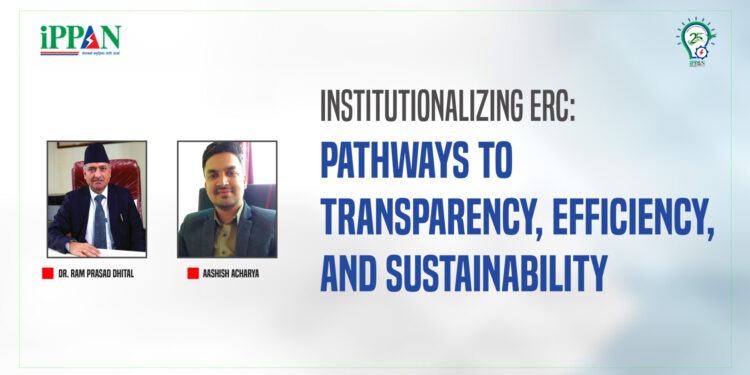
(Mr. Dhital is Chairperson and Acharya is Finance and Regulatory Affairs Specialist of ERC)